

If you are shipping a minibus overseas, whether it is a 16-seater for a school, a wheelchair-accessible vehicle for a charity, or a fleet for an NGO project, the basics of RoRo and container shipping apply the same way they do for any bus or coach. Minibus shipping from the UK does come with its own set of practical details worth knowing before you book. For the full comparison of shipping methods, current pricing, transit times, and general documentation, see our main bus and coach shipping page.
Ascope Shipping has handled minibus shipping from the UK to destinations across Africa, the Middle East, and beyond for over 15 years, sailing from Southampton, Immingham, Teesport, Bristol, and Sheerness. Minibuses are one of the most common vehicle types we handle for charities, schools, churches, and community organizations, and the process for these shipments often looks quite different from a standard commercial export.
Why Minibus Shipping Is Different From Standard Bus Shipping
On paper, a minibus is just a smaller version of a coach. In practice, the shipments themselves tend to fall into different categories with different priorities.
A retired school minibus or an ex-council vehicle being donated to a project overseas is usually older, sometimes non-running, and travelling for charitable rather than commercial reasons. A wheelchair-accessible minibus carries fitted equipment that needs specific protection during loading and transit. A fleet of minibuses being replaced or relocated needs careful coordination so vehicles arrive together rather than in a scattered, delayed sequence.
None of this changes the fundamentals of RoRo or container shipping. It does change what your shipping agent should be asking you before booking, and what documentation is worth having ready.
Wheelchair-Accessible Minibus Shipping
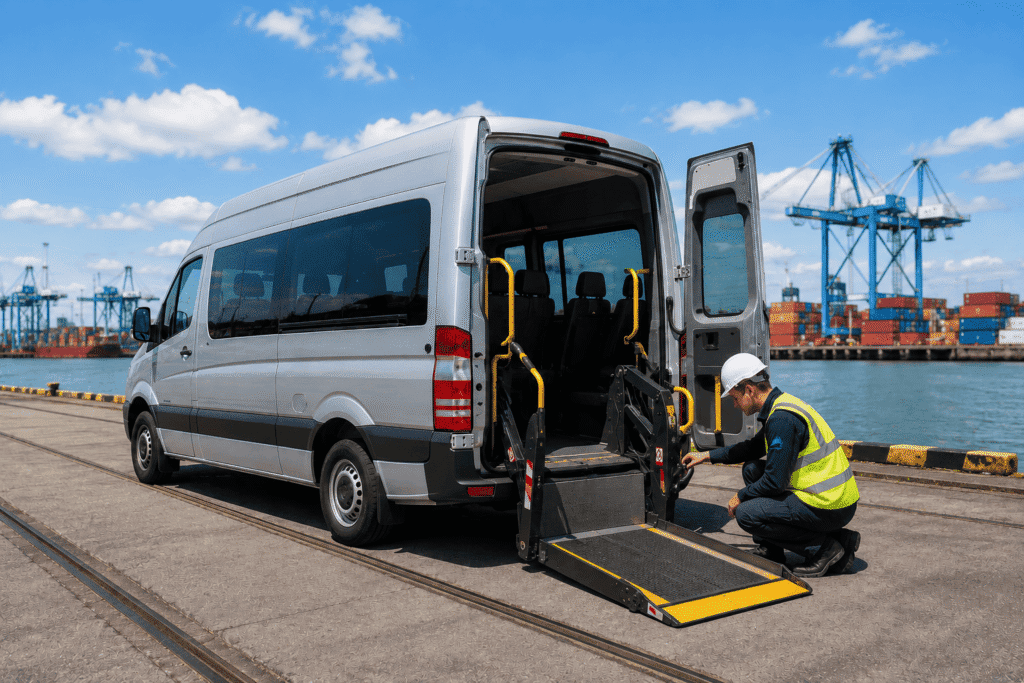
Wheelchair-accessible minibuses need extra care during loading and transit that a standard vehicle does not. Ramps, lifts, and internal securing points for wheelchairs can be vulnerable to damage if the vehicle is not loaded and strapped correctly, so it is worth confirming your agent has specific experience with adapted vehicles before booking.
Container shipping is generally the safer option for adapted minibuses, since it protects the ramp mechanism and any fitted equipment from exposure during the voyage. Salt air and repeated handling on an open RoRo deck are exactly the conditions that cause hinges, electrics, and hydraulic ramps to fail early. A sealed container removes that risk entirely.
If personal mobility equipment or spare parts are travelling with the vehicle, wheelchairs, ramps, hoists, or replacement parts for the lift mechanism, these can usually be declared and shipped inside the container alongside the vehicle, subject to customs requirements at the destination. This is one of the practical advantages of container shipping over RoRo, where nothing beyond the vehicle itself is permitted.
Before booking, it is worth photographing the ramp and lift mechanism in working order. This gives you a clear reference point if anything needs to be checked or repaired on arrival, and it supports any insurance claim should damage occur in transit.
Charity and NGO Minibus Exports
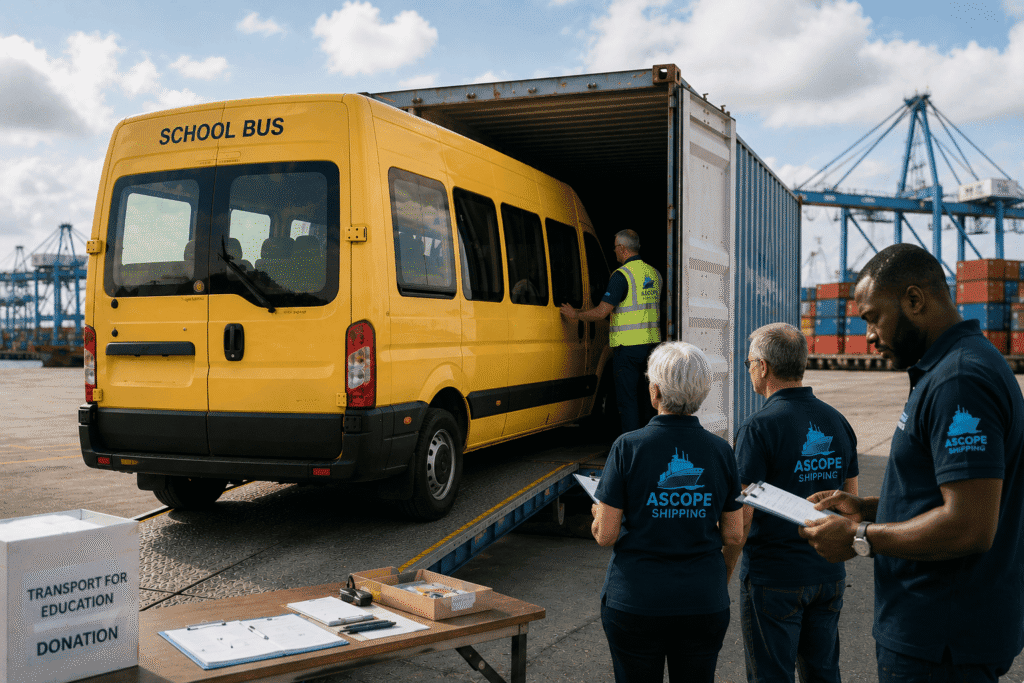
A significant share of minibus shipping from the UK is charity and NGO work. Retired UK school minibuses, ex-council vehicles, and church or community buses are regularly sent to schools, hospitals, and community projects overseas, particularly across Africa.
These shipments often come with their own considerations that standard commercial exports do not.
Vehicles may be older and non-running, which usually means container shipping rather than RoRo, since a vehicle that cannot be driven cannot go on a RoRo vessel under its own power. Specialist loading equipment handles this at the UK port, and the same applies again on arrival.
Registered charities may also be eligible for reduced import duty or VAT relief at the destination, depending on the country and the nature of the donation. This is not automatic, and requirements vary significantly by destination, so it is worth checking with the receiving organisation and, where possible, the destination customs authority before the vehicle ships. Documentation proving the vehicle’s charitable purpose, a letter from the receiving charity, evidence of the donation, and the vehicle’s intended use, can also help speed up customs clearance at the receiving end and avoid the vehicle being treated as a standard commercial import.
Ascope Shipping has supported a number of charity and community minibus exports over the years and can advise on what destination countries typically require for this type of shipment, based on what has worked smoothly for similar exports in the past.
Fleet Minibus Shipping from the UK
Shipping multiple minibuses in one consignment, common for schools, transport operators, and NGOs replacing a whole fleet at once, works best when planned as a single coordinated shipment rather than several separate bookings. For the full strategy behind coordinating multiple vehicles, see our fleet vehicle shipping page.
Consolidating a fleet into shared containers reduces cost per vehicle compared with shipping each one individually. Booking everything onto the same sailing also keeps the whole consignment moving through customs together at the destination, rather than having some vehicles clear while others are still in transit or held up in a separate container.
For larger fleets, it is worth planning collection so that all vehicles arrive at the UK port within the same window. Staggered arrivals can mean a vehicle sits waiting for the rest of the fleet before loading, which adds unnecessary storage time and cost. A single point of contact managing the whole fleet, rather than coordinating each vehicle separately, makes this considerably easier to manage from the UK side.
Documentation Specific to Minibus Shipping
Most of the documentation required for a minibus is the same as for any bus or coach export: the V5C logbook, proof of ownership, a commercial invoice, and a completed export declaration. See our main bus and coach shipping page for the full general checklist.
Two things are worth flagging specifically for minibuses.
If the vehicle is a registered charity donation, keep proof of the vehicle’s charitable status and its intended use alongside your standard shipping paperwork. Some destinations request this specifically for customs purposes, and having it ready from the outset avoids delays later.
For wheelchair-accessible vehicles, include a clear description of the fitted equipment, ramps, lifts, and securing points, on the commercial invoice. This helps avoid valuation disputes at destination customs, where an under-described vehicle can sometimes be queried or held for clarification. You can review the UK government’s guidance on exporting goods for the latest official requirements around export documentation.
Frequently Asked Questions
Can a non-running minibus be shipped from the UK?
Yes. Non-running minibuses are shipped by container, using specialist loading equipment rather than driving the vehicle on and off a RoRo vessel. This is common for older charity and school minibuses being retired from UK service.
Do charities get reduced shipping or import costs for minibus donations?
Some destination countries offer reduced import duty or VAT relief for genuine charitable donations, though this varies by country and is not automatic. Proof of the vehicle’s charitable purpose and the receiving organisation’s status is usually required, and it is worth confirming requirements with the destination before the vehicle ships.
Is it better to ship wheelchair-accessible minibuses by container?
In most cases, yes. Container shipping protects the ramp, lift mechanism, and any fitted accessibility equipment from exposure during transit, which matters more for adapted vehicles than for a standard minibus with no fitted mechanical equipment.
How many minibuses can be shipped in one container?
This depends on the minibus size and container type, but a 40ft container can often accommodate two to three standard minibuses, or fewer if larger accessible vehicles with fitted equipment are involved. Your shipping agent can confirm exact capacity once they know your specific vehicles.
What documents do charities need for a minibus donation shipment?
Alongside the standard export documents, it helps to have a letter from the receiving charity or organisation, evidence of the vehicle’s donation and intended use, and any destination-specific charitable import forms. Requirements vary by country, so check with your shipping agent and the receiving organisation early.
Ship Your Minibus with Ascope Shipping
Whether you are exporting a single wheelchair-accessible minibus, donating a retired school bus to a charity project overseas, or moving a fleet of minibuses for an NGO, Ascope Shipping handles the details that generic shipping guides tend to miss when it comes to minibus shipping from the UK.
With over 15 years of experience shipping vehicles from the UK, including a considerable number of minibuses for schools, charities, and community organisations, we know what destination countries typically ask for and how to keep these shipments moving smoothly.
Get in touch for a tailored quote for your minibus shipping from the UK needs. Call us on 01482 228366 or email sales@backup.ascopeshipping.co.uk, and our team will talk you through the right method for your vehicle and destination.