

Construction Equipment Shipping: Breakbulk, Open-Top & Special Cases
Most construction equipment shipping from the UK fits neatly into RoRo, flat rack, or standard container methods. But some machinery does not. Abnormal loads, cranes that will not fit inside any container, and older or used equipment facing destination-country age restrictions all need a different approach, and this is exactly where standard shipping guides fall short. For the general RoRo, flat rack, and container comparison, current pricing, transit times, and full documentation checklist, see our main heavy plant machinery shipping page.
Ascope Shipping has been handling international construction equipment shipping from the UK for over 15 years, moving excavators, diggers, cranes, and heavy machinery to destinations worldwide.
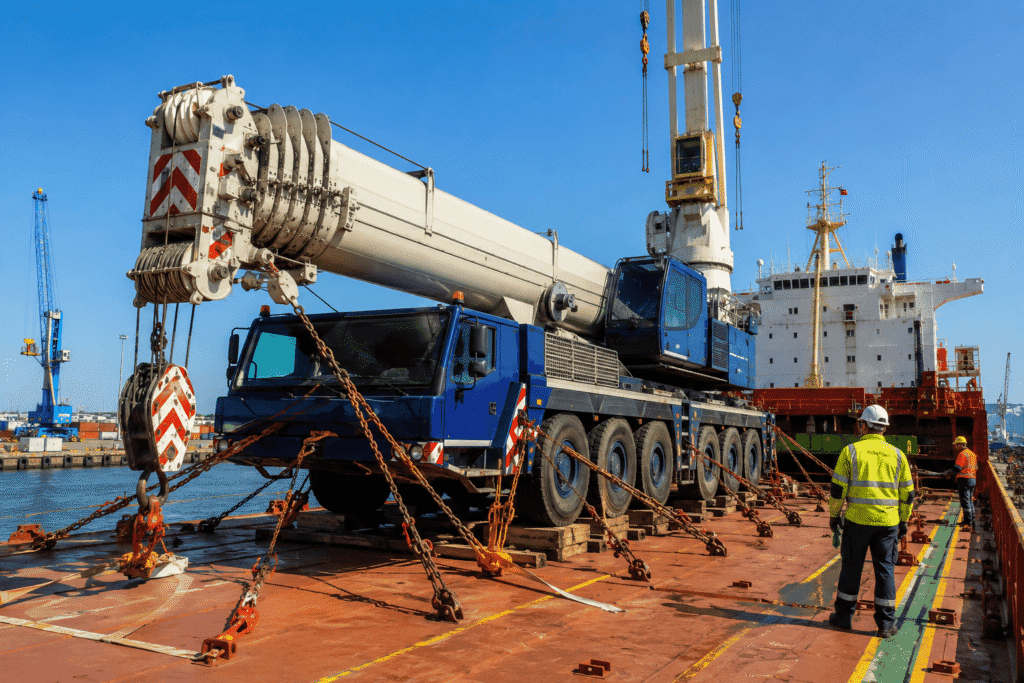
When Standard Methods Don’t Work: Breakbulk Construction Equipment Shipping
Breakbulk shipping for construction machinery UK exports is used when equipment is too large, too heavy, or too irregularly shaped to load into any standard container and often too large even for a flat rack.
Breakbulk works for:
- Mobile cranes and crawler cranes exceeding standard flat rack dimensions
- Project cargo: multiple pieces of equipment shipped as a coordinated single consignment
- Abnormal loads that exceed standard height, width, or length limits by a significant margin
- Machinery that cannot be safely broken down or dismantled for container loading
With breakbulk shipping, cargo is loaded individually onto the vessel’s deck or into the hold, secured with specialist lashing, chains, and dunnage rather than being contained within a box. This is the most labour-intensive and typically the most expensive method, but for certain equipment it is the only realistic option.
Project cargo construction equipment UK exports often combine breakbulk with other methods in a single shipment: the main crane or excavator ships breakbulk, while smaller attachments, spare parts, and tools travel by container on the same route. Coordinating this properly, so everything arrives at the destination port within the same window, is where an experienced freight forwarder genuinely earns their fee. Poor coordination here means equipment sitting idle at the destination waiting for the attachments needed to make it operational.
Breakbulk shipping also typically requires more lead time than RoRo or container bookings. Vessel space for breakbulk cargo is more limited and scheduled further in advance, so booking early is essential if your project has a fixed start date at the destination.
Open-Top Container Shipping for Construction Equipment
An open-top container is a standard-length container with a removable canvas or tarpaulin roof instead of a solid steel top. It solves a specific problem: equipment that fits within the container’s length and width but exceeds the standard height.
Open-top containers work well for:
- Excavators and diggers with the boom or arm raised beyond standard clearance
- Equipment with a fixed structure taller than a standard container roof, but not so tall that it needs breakbulk
- Machinery that needs top-loading by crane rather than driving or winching in through the container doors
Because the roof opens fully, equipment can be lowered straight in from above using a crane, rather than being manoeuvred through the container’s rear doors. This matters for equipment with awkward dimensions or a high centre of gravity that would be difficult to load conventionally.
Once loaded, the tarpaulin roof is secured back over the equipment, and a waterproof cover protects against rain during transit, though open-top containers offer less complete weather protection than a fully enclosed standard container. For equipment that is not moisture-sensitive, this trade-off is generally acceptable given the loading flexibility it provides. See our main container shipping page for the wider range of container options available.
Open-top shipping sits between flat rack and standard container in terms of cost and protection. It is worth discussing with your shipping agent whether your specific equipment’s dimensions genuinely require an open-top, or whether a standard container would work with the boom or arm partially dismantled or repositioned, since dismantling where possible can bring the cost down considerably.
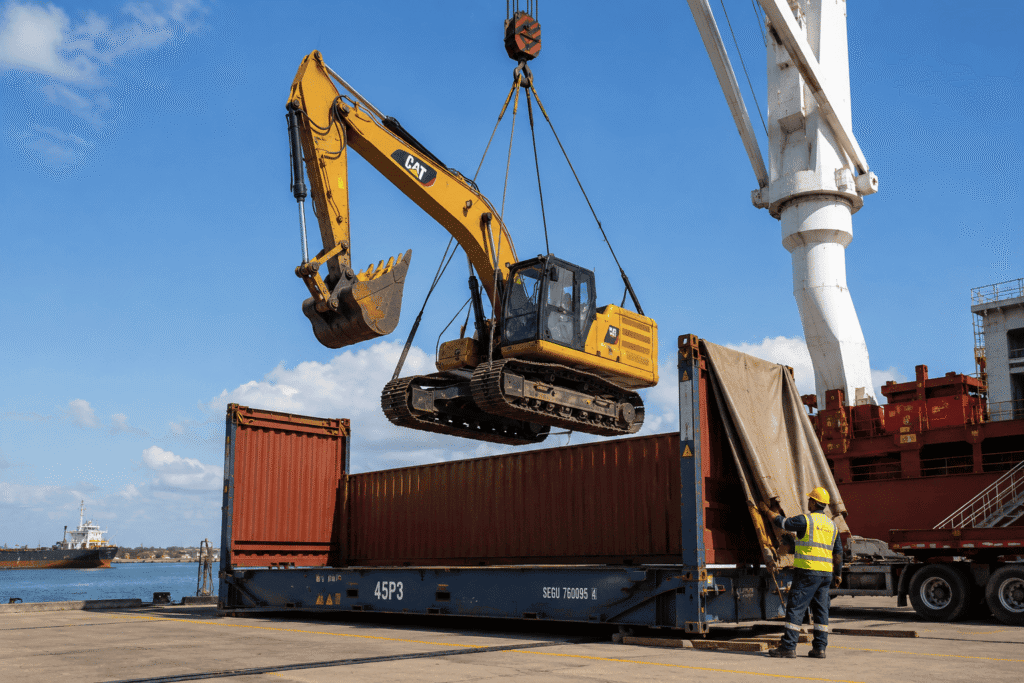
Can I Ship a Used Excavator from the UK Overseas?
Yes, used construction equipment shipping from the UK is common and legal to virtually all destinations. However, the destination country’s import rules, not UK export rules, are what determine whether a specific used machine can actually enter and be registered for use.
Age Restrictions on Imported Construction Machinery
This is one of the most frequently asked questions we get at Ascope Shipping, and one that catches exporters out because the rules vary significantly by country and are not always well publicised.
Common types of restriction include:
- Maximum age limits: some countries restrict imports of heavy machinery over a certain age, commonly somewhere between 10 and 15 years old, though the exact limit and how strictly it is enforced varies by country and by equipment type
- Emissions standards: certain destinations require machinery to meet minimum emissions standards, which can effectively exclude older diesel equipment regardless of its mechanical condition
- Safety certification: some countries require re-certification or inspection of used machinery before it can be registered for commercial use
- Import licensing: used equipment may require specific import permits that new equipment does not, adding time to the customs process
Certain African nations apply particularly strict rules on machinery import age, and requirements can change with little notice as governments update trade and environmental policy. Before committing to purchase or shipment of used equipment for a specific destination, confirm the current rules directly with the destination country’s customs authority or your shipping agent, rather than relying on general guidance that may be out of date. Ascope Shipping checks current import rules for the specific destination before every used-equipment booking, precisely because these rules shift.
Documentation for used equipment typically needs to demonstrate:
- The equipment’s manufacture date, usually via a data plate, manufacturer’s certificate, or service history
- Its mechanical condition and safety compliance
- In some cases, an inspection certificate confirming it meets destination emissions or safety standards
Getting this wrong is expensive. A machine that ships without the right paperwork, or that turns out to exceed the destination’s age limit, can be refused entry, held in bonded storage accruing daily charges, or in the worst case, sent back to the UK at the owner’s cost. Checking eligibility before you buy, not after you have already paid for shipping, is the only way to avoid this risk entirely.
Insuring High-Value or Irregular Construction Equipment
Breakbulk and open-top shipments carry a different risk profile to standard container cargo, since equipment is more exposed during loading, transit, and unloading. Marine cargo insurance for construction machinery export is strongly recommended for any breakbulk or high-value shipment, covering physical damage during loading and transit, loss at sea, and handling damage at the destination port. See our marine cargo insurance page for coverage options tailored to your equipment’s value and shipping method.
For breakbulk cargo specifically, it is worth confirming with your insurer whether the policy covers the specific lashing and securing method being used, since claims disputes on breakbulk cargo often centre on whether the equipment was secured to an insurable standard.
Documentation Specific to Construction Equipment Shipping: Breakbulk and Special Cargo
Most of the documentation required is the same as for standard construction equipment export: commercial invoice, bill of lading, packing list, and export declaration. See our main heavy plant machinery shipping page for the full general checklist.
For breakbulk and project cargo specifically, it is worth having ready a detailed loading and lashing plan, agreed with the carrier before the vessel arrives, and confirmation of the equipment’s exact weight and dimensions, since inaccurate figures here can affect both the booking and the insurance cover. You can review the UK government’s guidance on exporting goods for the latest official requirements around export documentation.
Frequently Asked Questions
What is the difference between breakbulk and flat rack shipping?
Flat rack shipping uses a container-sized platform with no sides, still loaded and craned like a container. Breakbulk shipping has no container element at all: cargo is loaded and secured individually on the vessel’s deck or hold. Breakbulk is used when equipment exceeds even flat rack dimensions.
Can I ship an excavator with the boom raised in a standard container?
Usually not, since a raised boom typically exceeds standard container height. An open-top container is the usual solution, allowing the equipment to be craned in from above, or the boom can sometimes be lowered or partially dismantled to fit a standard container instead.
Is there a maximum age for importing used construction machinery?
This depends entirely on the destination country. Many countries apply age limits, commonly between 10 and 15 years, though this varies significantly and can change. Always confirm current rules with the destination customs authority or your shipping agent before shipping used equipment.
Do open-top containers protect equipment from rain during shipping?
Partially. A waterproof tarpaulin cover is fitted over the open roof, offering reasonable protection, but it is not as watertight as a fully enclosed steel container. For moisture-sensitive equipment, a standard or flat rack container is generally the safer choice if dimensions allow.
How far in advance should I book breakbulk shipping?
Breakbulk vessel space is more limited and scheduled further ahead than standard container or RoRo sailings. Booking at least 6 to 8 weeks in advance is advisable for breakbulk and project cargo, longer for less common routes or larger consignments.
Ship Special Case Construction Equipment with Ascope Shipping
Whether you are exporting an oversized crane, coordinating a multi-piece project cargo shipment, or need to check whether a used excavator will clear customs at its destination, Ascope Shipping handles the details that standard shipping methods do not cover.
With over 15 years of experience in international construction equipment shipping from the UK, we advise on the right method for genuinely oversized or unusual equipment, check current used-equipment import rules before you book, and arrange marine insurance suited to breakbulk and high-value cargo. For the full range of standard shipping methods, current pricing, and general documentation, get in touch to discuss your specific equipment and destination. Call us on 01482 228366, WhatsApp +447717769925, or email sales@backup.ascopeshipping.co.uk.